Diverse and Adaptable Arm Coordination for Octopus-Crawling via Diffusion-Based Uncertainty-Aware Optimization
View BibTeX
@misc{kim2026octopuscrawling,
  title         = {Diverse and Adaptable Arm Coordination for Octopus-Crawling via Diffusion-Based Uncertainty-Aware Optimization},
  author        = {Kim, Seung Hyun and Chang, Heng-Sheng and Kazemi, Kimia and Mehta, Prashant and Gazzola, Mattia},
  year          = {2026},
  eprint        = {2609.21138},
  archivePrefix = {arXiv},
  primaryClass  = {cs.RO},
  url           = {https://arxiv.org/abs/2609.21138}
}Abstract
Octopus crawling motivates soft robots that exploit redundancy, yet discovering and organizing diverse coordination modes for adaptation remains challenging. To address this, we introduce a Diffusion-based Uncertainty-aware Optimization (DUO) algorithm that learns demonstration-free crawling controllers for a simulated, muscle-actuated CyberOctopus. This work represents the first application of diffusion-based control to soft multi-arm robots in contact-rich simulations. By embedding a variety of locomotion behaviors within a shared control distribution, this approach enables the simulated octopus to navigate dynamic physical constraints, demonstrating that learned coordination diversity inherently facilitates robust adaptation. The main contributions include: (i) a symmetry-structured policy representation that folds radially equivalent controllers into a canonical directional sector, (ii) an online black-box optimization strategy, the DUO algorithm, that discovers and retains diverse coordination modes, and (iii) a control editing technique that adapts existing controllers to novel actuator constraints without retraining. These results show how learned coordination diversity makes motor abundance a practical resource for adaptation in soft multi-arm robots.
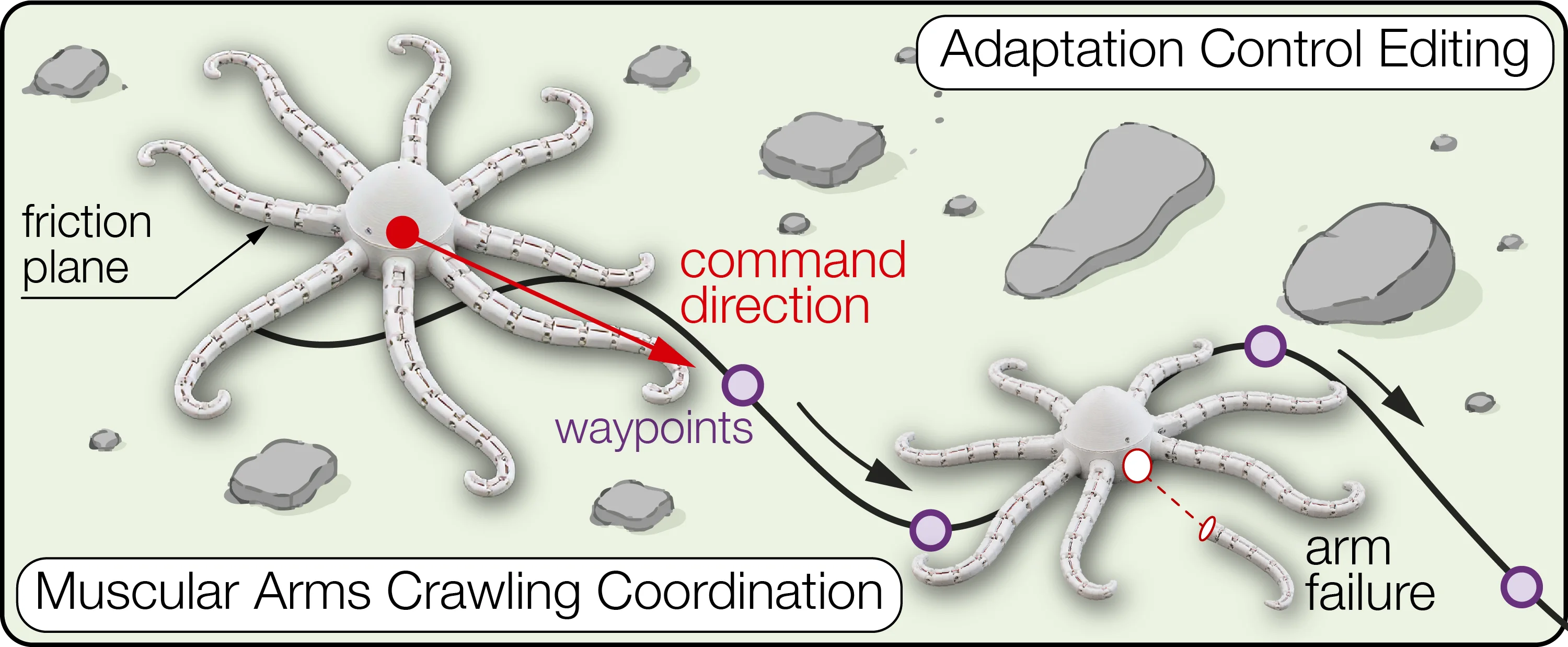
One body. Many ways forward.
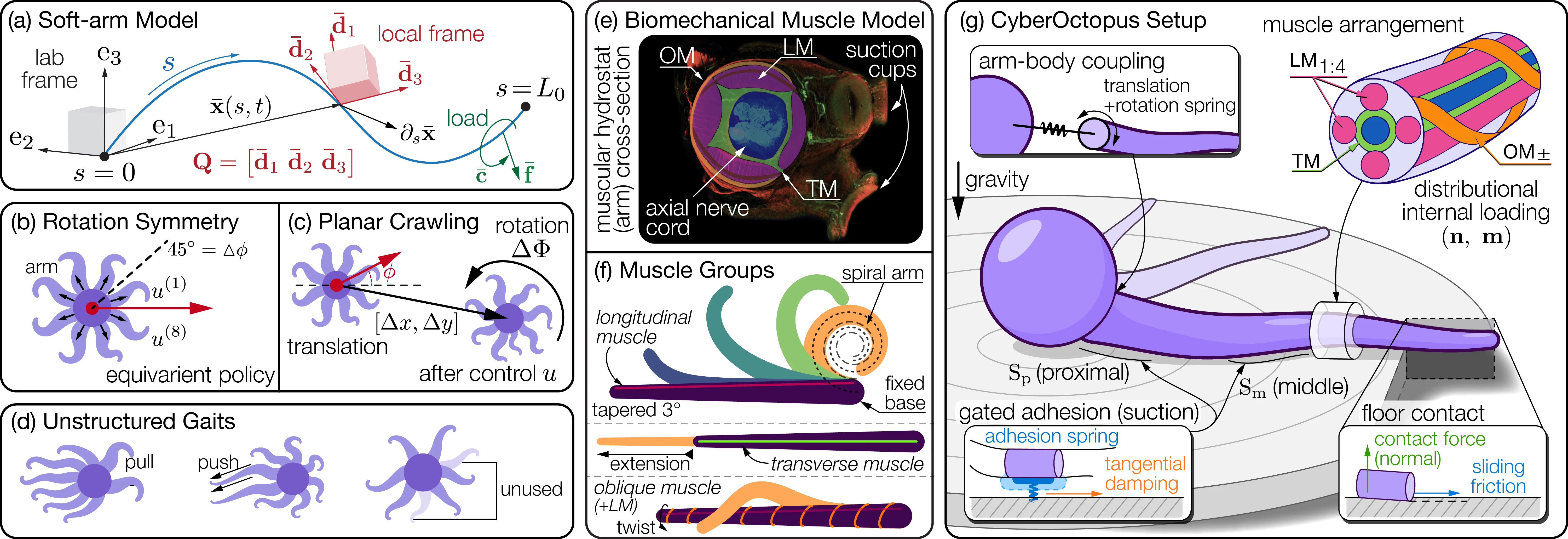
Soft, redundant arms make octopus-like crawling remarkably flexible. They also make it difficult to discover and organize the many coordination patterns that can achieve the same movement.
We study this problem in a physics-based, muscle-actuated CyberOctopus with eight radial arms. Each arm is modeled as a Cosserat rod, and distributed muscle actuation drives contact-rich crawling over a frictional plane.
Rather than selecting one best controller, our approach learns a distribution of effective coordination modes. Keeping these alternatives available gives the robot options when physical constraints change.
Discover, retain, reuse.
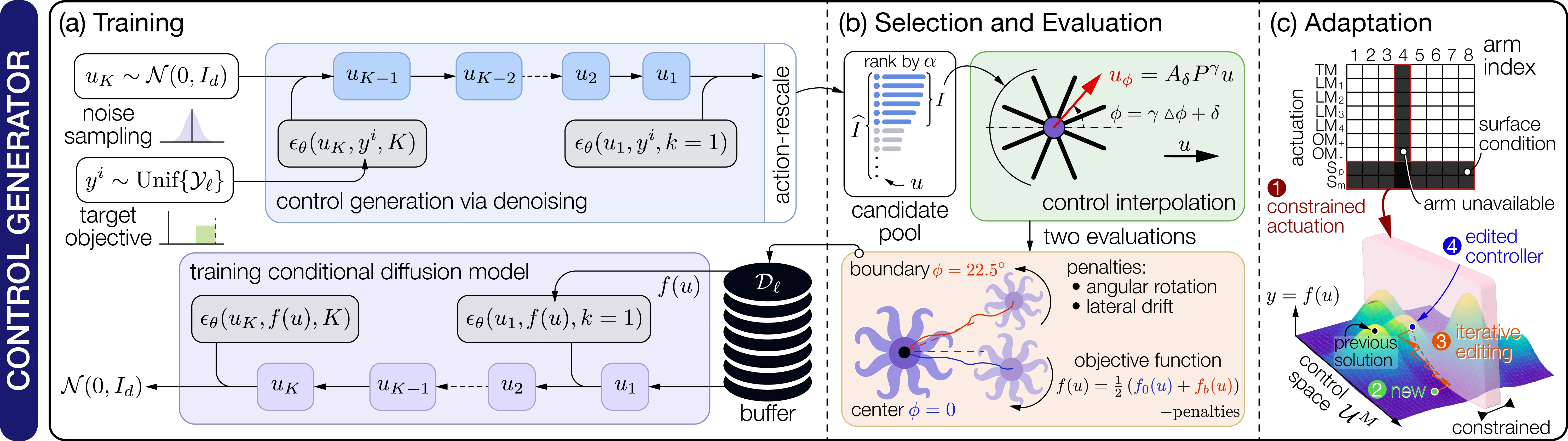
Diffusion-based Uncertainty-aware Optimization (DUO) searches for effective crawling without demonstrations. Rotational symmetry folds equivalent directions into one canonical sector; interpolation and boundary evaluations extend the resulting controls across all commanded headings.
Within that reduced search, DUO uses predictive uncertainty to choose informative simulations and learns a multimodal control distribution that retains diverse coordination modes. When an actuator fails or surface friction changes, control editing can reuse that learned diversity without retraining the diffusion model.
Different coordination, shared direction.
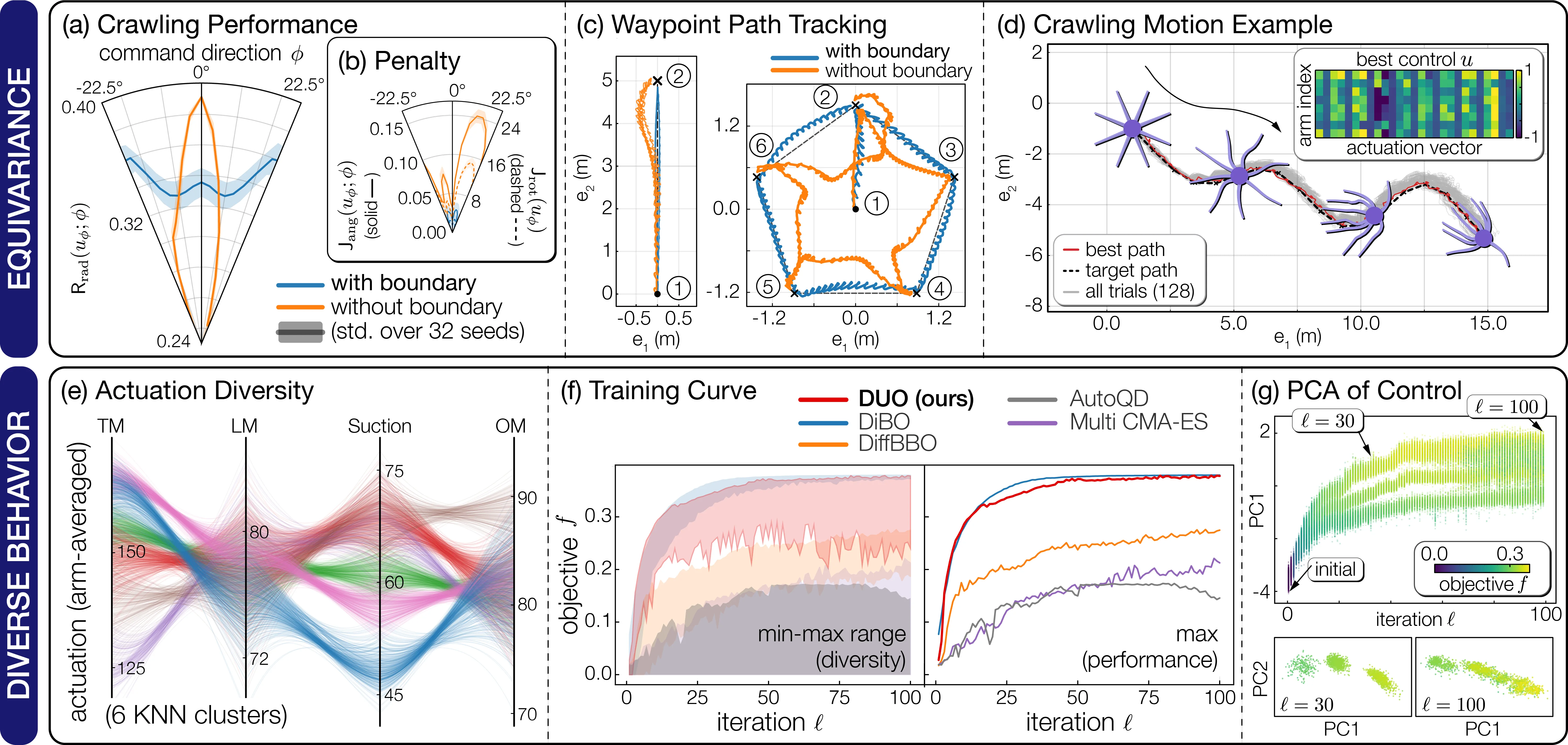
The learned controllers recruit arms in distinct ways while supporting directional crawling. Evaluations across the canonical sector show that boundary-aware optimization improves consistency between arm-aligned directions, where interpolation otherwise loses performance.
Adapt when actuation changes.

The retained control distribution provides starting points for constrained control editing. Across tested actuation constraints, editing recovers about half or more of the lost crawling objective, including when four alternating arms are unavailable, without additional diffusion-model training.